



Give the work a clear shape
A useful request names the subject, the desired output and the constraint:Review the description of our linen shirt. Use the product facts and our tone of voice. Draft a clearer version, flag unsupported claims and show the sources.Follow-up questions can refine the work: “Make that shorter”, “Explain why that claim is unsupported”, or “Compare the current and proposed wording”. Keep refining the draft until it is ready to review.
Check the evidence
Look for the source, the period covered and any missing information. A polished answer can still be limited by an unconnected service, a stale source or a provider’s permissions. If the evidence is incomplete, ask what is missing before making a decision. Kina should explain what it prepared and what remains to be done. An answer in a conversation does not by itself prove that a provider change happened. Use the Action and its receipt for that.Use the right company and source
Your company context, account permissions and connected capabilities bound what Kina can read and prepare. Asking in natural language does not expand those permissions. For customer enquiries, avoid pasting unnecessary personal data into a conversation; use the supported, authorised source.Complete an investigation, then choose its next step
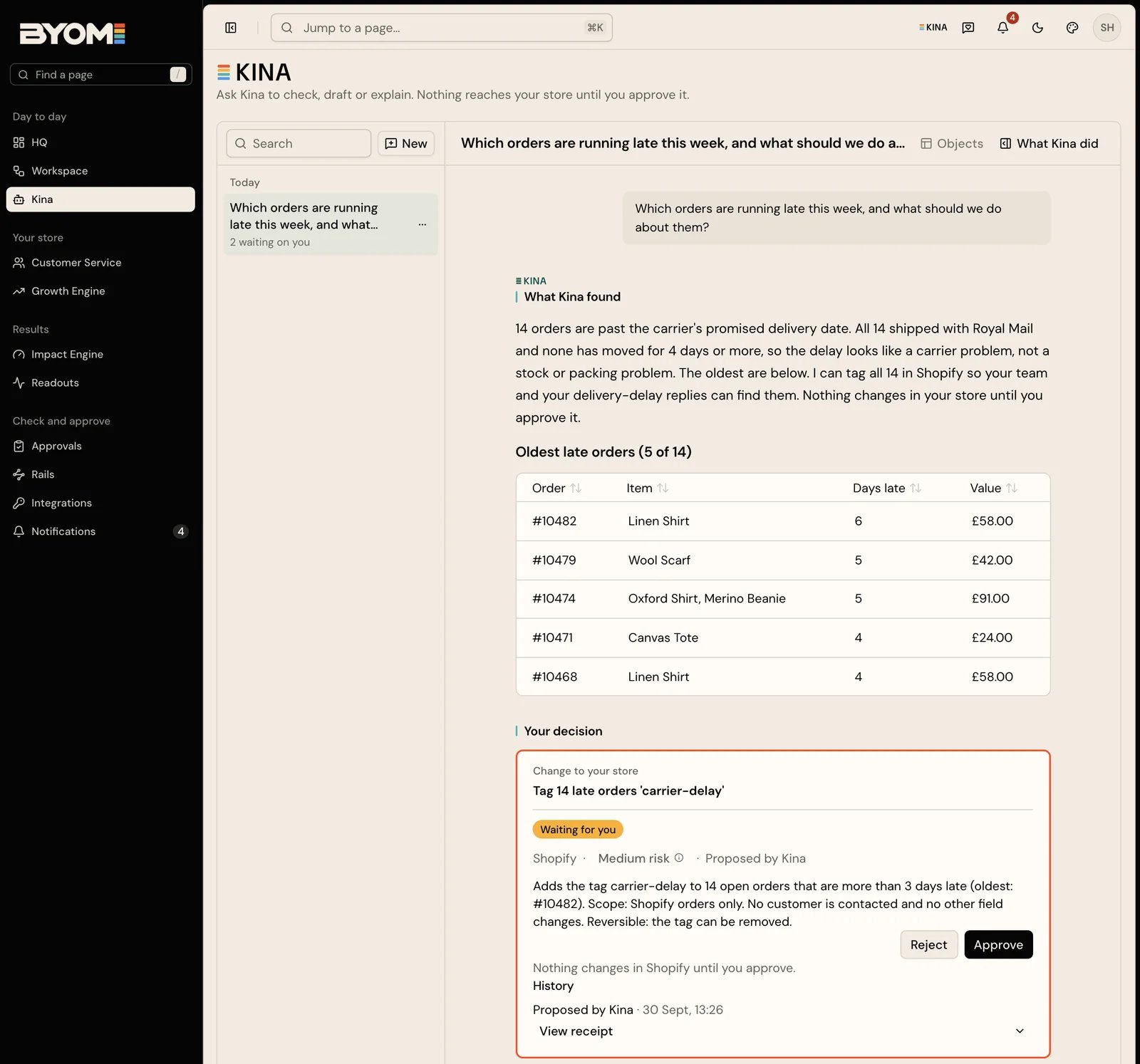
Illustrative demo of a Kina conversation and its prepared work. This is not a live account or a completed merchant outcome.
- Define the subject. Name the product, work record or enquiry. For a trading question, specify the dates and whether you mean a count, a rate or a monetary amount.
- Request an inspectable output. Ask for the source facts, a conclusion and the uncertainty. If you need a draft, identify the intended audience and constraints.
- Check the result before continuing. Open the cited source where available. Follow up in the conversation to resolve a missing fact or correct a mistaken assumption.
Worked example: an unsupported product claim
The fictional merchant North Coast Goods asks Kina to review a cotton overshirt. The product record says “100% cotton” and gives washing instructions; the draft description also says “certified organic”. No certification source is available. A useful result identifies the unsupported claim, retains the verified composition and proposes wording without the certification. It also explains what evidence would be needed to include that claim. Your next step can be to supply the missing source or prepare a change using the supported facts. Ask a follow-up such as “Keep the verified facts and give me the proposed description beside the current one.” If you then choose to apply it, inspect the proposed change in Approvals. Review the exact changed fields before authorising the update.Talk through the work
Where calls are enabled for your account, use Call in Kina and grant your browser microphone access when prompted. Start with the same subject, desired output and constraints you would put in a written request. The call joins the conversation on screen; use the chat to inspect the answer, sources and any prepared change. The call controls have separate purposes:- Microphone mutes what you send to the call. It does not cancel work already started.
- Kina’s voice turns spoken replies off or on. Kina can continue answering in text with its voice off.
- End ends the call. Work already started can continue in the chat; check its result there.